For newbies, there are three critical skills that you need to develop: Line of Safety, Map Awareness, and Vision Control
Sense of Danger
Developing a sense of danger requires basic logic and an understanding of the basic mechanics of the game. I utilize a principle I call “Safety Line or Line of Safety” and we will go deeper about it in this guide.
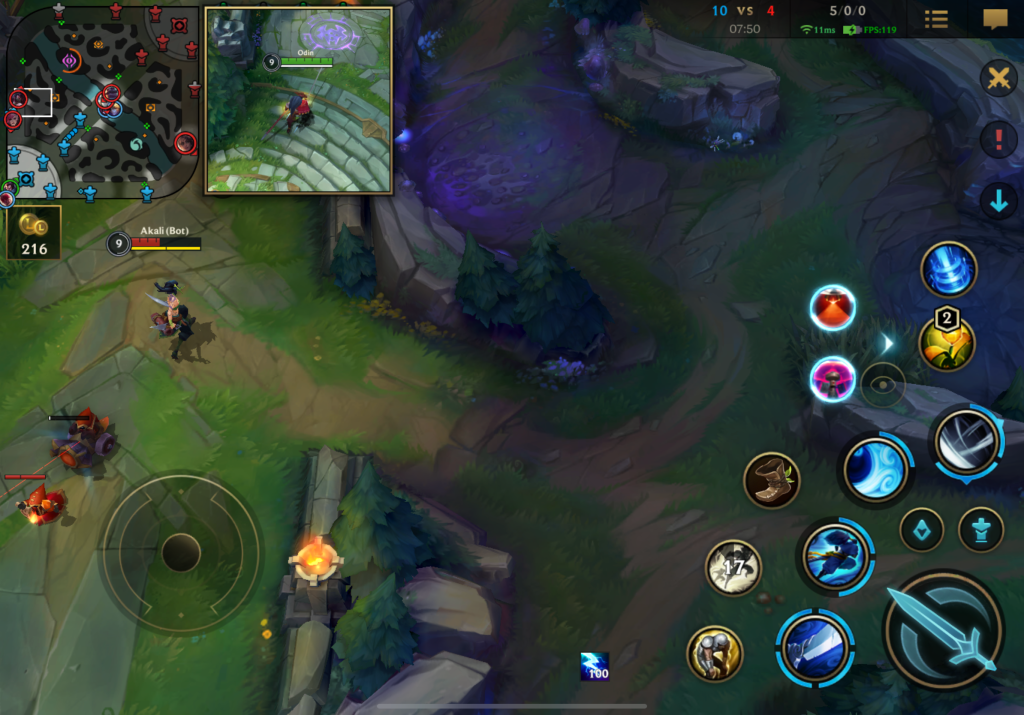
By now, you should already be aware of the system called the fog of war. In case you don’t, “Fog of war” refers to the areas of the map that are not currently visible to a player’s team. These areas are covered in a “fog” that hides enemy champions, objectives, and other important information from view. The image below that shows a dark area next to the Akali Bot is called a fog of war.
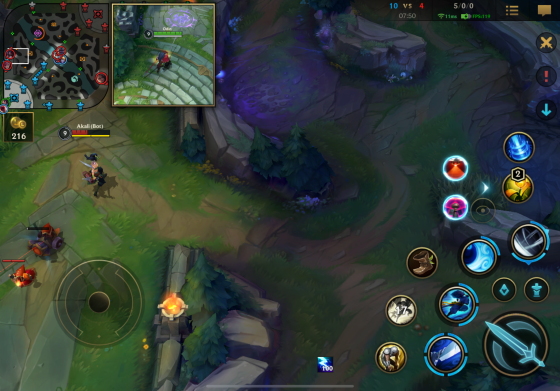
Fog of war is a key element of Wild Rift’s gameplay, as it adds an element of uncertainty and risk to every match. Players must be aware of the areas covered by the fog of war and take steps to reveal them, either by moving into those areas themselves or by using wards or other vision-enhancing items.
A simple way I have always taught my friends is to always draw a line of safety in your mind. What does this mean? Look at the image below
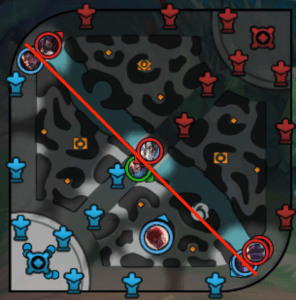
The line of safety is a line in which we can cross where it will be fairly safe to stand there without the risk of death. A general rule is to stay behind this line at all times when not going for a kill or an objective.
A few things come into factor when drawing this line of safety:
- Where are our allies now
- How many towers are still up
- Which area do we not have a vision of (fog of war)
- Where are the enemy champions
To understand this step better, we need to first develop our map awareness skills.
Map Awareness
Map awareness is a critical skill in Wild Rift that allows players to stay informed about what’s happening on the map, anticipate enemy movements, and make strategic decisions based on the current state of the game. Good map awareness can help you avoid ganks, secure objectives, and make informed decisions about where to push or retreat.
Here are some tips for improving your map awareness in Wild Rift:
- Keep an eye on the minimap: The minimap is your window to what’s happening on the map. Make a habit of checking it regularly, especially during downtime like farming or waiting for respawn timers. Look for enemy champions, incoming minion waves, and objective timers.
- Use vision to your advantage: Wards and trinkets are essential for maintaining vision control on the map. Place wards in key locations like river bushes or choke points to detect incoming enemy movements. Make sure to replace wards as they expire to maintain vision control.
- Pay attention to audio cues: Wild Rift has audio cues that can give you information about what’s happening off-screen. Listen for things like enemy champion abilities, dragon or Baron roars, or the sound of turrets firing to get a sense of where the action is.
- Communicate with your team: Share information with your team about what you see on the map. Ping enemy movements or objective timers, and let your team know when you spot a potential gank or opportunity for a team fight.
- Anticipate enemy movements: Based on the information you gather from the minimap and audio cues, try to predict where the enemy team is headed. This can help you avoid ganks and position yourself to take advantage of opportunities on the map.
Improving your map awareness in Wild Rift takes practice and effort, but it’s a critical skill for any player looking to climb the ranks. By keeping an eye on the minimap, using vision to your advantage, paying attention to audio cues, communicating with your team, and anticipating enemy movements, you can stay one step ahead of the competition and make strategic decisions that lead to victory.
Utilizing the Line of Safety
Now that you understand what map awareness is, keep the 5 steps in mind and start developing it in every game that you play. Map awareness will allow you to draw the line of safety at all times when playing the game.
We can now go back to the 4 factors affecting the line of safety:
- Where are our allies now
- How many towers are still up
- Which area do we not have a vision of (fog of war)
- Where are the enemy champions
These four factors are always dynamically changing which means that the line of safety is always constantly moving. Let’s try changing some of the conditions and draw new lines of safety. Do you know where to draw the line of safety for this image below?
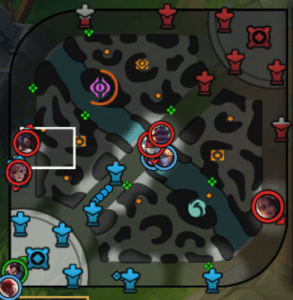
We need to go over the four factors I’ve written above and try to draw a line where it’s safe.
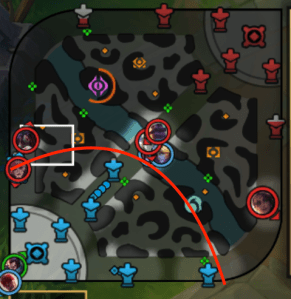
Here is the actual line of safety that we will draw according to the four factors above. Here’s the analysis for you.
Factor 1: We have 2 allies in Mid fighting the enemy
Factor 2: The first tower on top is down
Factor 3: Areas of no vision does not really matter much now since we can see all of the enemies
Factor 4: We can see 2 enemies in Top, 2 in Mid, and 1 in Bot.
In case you missed our explanation of the different lanes and roles, click here.
To establish the line of safety, we can commence from the top tower where the two enemies are present and stretch it through the mid-lane where our allies are currently battling, all the way to the first turret in the bot lane. It is a straightforward process that requires you to always keep this in mind for every game you play. Nevertheless, in this scenario, Factor 3 is not as important as we can see all the opponents on the map. However, the line of safety will be very different when they go missing. In order to keep the line of safety back, we must ensure the presence of wards and have better vision in the fog of war.
Defensive Vision Control
In order to keep the line of safety as far as possible we need to learn how important vision control is. Warding is a crucial aspect of Wild Rift gameplay that involves placing wards on the map to reveal enemy movements and keep your team informed about what’s happening. By placing wards in strategic locations, you can gain valuable information about the enemy team’s movements and objectives, allowing you to make better decisions and avoid unnecessary deaths.
We will go into other aspects of warding later on in another guide. In this guide, we will just focus on the aspect of defensive warding to help stay safe. In this case, we want to place wards in the following places that serve as choke points in the jungle area as shown below. We can draw the same lines even if the enemy is missing if we have vision in these choke points.

Conclusion
Remember, it is important to learn these skills and keep developing them in order to stay ahead in the game to avoid dying. Being able to draw a line of safety will ensure that you have the lowest chance of getting killed and winning the game. In order to do that, you must master Map Awareness, Safety Line, and Defensive Vision Control.

 Gamer's Handbook
Leave a reply to Wild Rift: Lane Management – Gamer's Handbook Cancel reply